
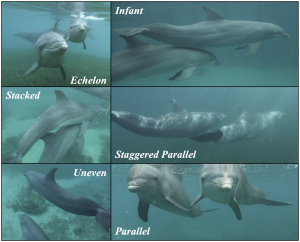
We are pleased to present our recently published paper in Behaviour:
Themelin, M., & Dudzinski, K. M. (2025). Bottlenose dolphins (Tursiops truncatus) pair swimming positions in non-mother–calf dyads. Behaviour, 1–39. DOI:10.1163/1568539X-bja10333
In this paper we explore the use of six pair swimming positions (PSP) in bottlenose dolphin dyads based on each partner’s sex and age. The patterns observed suggest each PSP could have different functions in dolphin social interactions.
Abstract:
Infant and echelon positions have been described as infant carrying behaviours in cetacean mother–calf pairs, though these positions (and others) are used through adulthood. From 59 sessions (approx. 1854 min) of underwater video recordings of a group of managed care bottlenose dolphins, position of each dolphin in a dyad swimming in the same direction were recorded on a 3-D axis to identify all possible pair swimming positions (PSPs) used by non-mother–calf pairs. A total of 166 min of PSPs was recorded and six PSPs with specific components such as proximity, synchrony, and contact were identified. All PSPs could be categorized as high proximity/contact (HPC-PSP: infant, echelon, stacked) or low proximity/contact (LPC-PSP: staggered parallel, parallel, uneven) swim positions, with 81% of the high proximity and 90% of the documented contact both occurring between individuals in infant position. Infant and echelon positions showed the least synchrony between partners whereas staggered parallel and parallel together accounted for more than 55% of synchronous PSPs. Specific patterns of PSP use by dyads based on their sex and age combinations were evident; for example, only adult male dyads were observed in stacked position, and the infant position between adult females almost always involved a pregnant female. These observations suggest that the social function(s) of each PSP might differ based on sex and age of the dyad, and potentially reproductive status. Our results represent the first deep dive into the nuanced subtleties of pair swim positions between partners in dolphin dyads to offer insight into how use of different PSP might allow for development and then maintenance of relationships within bottlenose dolphin society as individuals mature and assume their place in the social group.
The article is accessible at the link below or you can email DCP to request a PDF:
DCP will host a Deep Dive webinar on this topic on Monday 26 January 2026 at 17:00 EST (New York). Details can be found here.