
Exploring Animal Behavior Through Sound: Volume 2 has been published! And inside you’ll find the chapter, “Aquatic Mammals.” Kathleen is first author and DCP congratulates her and all the co-authors on this great work. And guess what? This is open access, which means you can download it for free! Keep reading for the abstract and link.
Dudzinski, K. Charrier, I., Erbe, C., Maust-Mohl, M., McFadden, S., Miksis-Olds, J., Reidenberg, J. S., & Thomas, J. A. (2025). Aquatic Mammals. In: Erbe, C., Thomas, J.A. (eds) Exploring Animal Behavior Through Sound: Volume 2. Springer, Cham. https://doi.org/10.1007/978-3-031-83460-8_9.
Abstract:
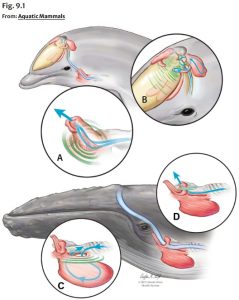
Marine mammals include species that depend on the ocean for all or part of their life needs: mysticetes (baleen whales), odontocetes (toothed whales, dolphins, and porpoises), pinnipeds (seals, sea lions, fur seals, and walruses), sirenians (manatees and dugongs), and the marine carnivores (sea otters and polar bears). A few other groups of mammals are adapted to a semiaquatic (or amphibious) life: rodents such as the beaver (Castor canadensis), muskrat (Ondatra zibethicus), and capybara (Hydrochoerus hydrochaeris); several mustelids such as the river otter (Lontra canadensis), giant otter (Pteronura brasiliensis), and marine otter (Lontra felina); and the hippopotamus (Hippopotamus amphibious). The primary sensory modality for marine mammals and other semiaquatic animals is hearing. These animals produce sound in support of critical life functions such as feeding, breeding, and nursing. However, underwater noise may interfere with acoustic communication and hearing. In this chapter, sound production mechanisms, types of sounds produced, hearing anatomy and physiology, hearing abilities, sound usage, and the effects of noise on aquatic mammals are summarized.
Head here to access the chapter.